


You booked the studio. Everyone looks good. The products are lined up. Your phone has storage. A minor miracle.
And then someone asks, “Okay, what should we film first?”
This is exactly why a shot list deserves a spot in your content shoot prep.
A good content shoot should leave you with more than a handful of pretty clips and one Reel. You want a bank of footage you can turn into Stories, voiceovers, educational posts, service features, and future content you have not even thought of yet.
So before your next content day, here is what we would make sure you capture

1. Start With Everyday B-Roll
The easiest footage to reuse is often the stuff that feels almost too simple to film.
Think about what normally happens inside your business. Opening the studio. Setting up your workstation. Packaging an order. Preparing a treatment room. Typing on a laptop. Putting products on a shelf.
These clips do not need a full concept attached to them while you are filming. That is exactly why they are useful.
General B-roll can sit underneath a voiceover, support educational text, introduce a service, or fill gaps in a longer Reel. Instead of needing new footage every time an idea comes up, you already have options.
A content creation process you can actually stick to makes it much easier to keep this kind of footage stocked for future posts.
2. Film Your Actual Process
People see the finished product all the time. Show them what happens before it gets there.
A hairstylist might capture mixing colour, sectioning hair, and styling. A bakery could film decorating and packaging. A skincare clinic might capture room preparation, products being selected, or appropriate parts of a treatment.
Instead of filming the entire process from one spot, get a wide shot, close-up, hands working, side angle, and a few details.
One process can give you several completely different clips without requiring several different ideas.
3. Get the People Behind the Business on Camera
Yes, this includes you.
Having footage of the actual people behind your brand makes your content bank much more versatile.
Capture your team working, setting up, chatting, walking through the space, interacting with products, or doing what they normally do. Then grab a few cleaner shots of someone looking at the camera, holding a product, or entering the space.
If everyone suddenly forgets how arms work when a camera appears, give them something to do. Movement usually looks more natural than asking someone to stand perfectly still and “act candid.”
TaSa’s portfolio shows how people, processes, products, and environments can work together to create a fuller picture of a business.
4. Record Some Talking Clips
If you are already dressed, mic’d up, and standing in good lighting, take advantage of it.
You do not need to film ten complete Reels. Instead, record short answers, FAQs, opinions, and explanations that can become content later.
Try questions like:
● What do customers ask us all the time?
● What do people misunderstand about this service?
● What should someone know before booking?
● What is something we wish more customers knew?
Keep each answer focused on one idea. Short, self-contained clips are much easier to reuse.
And if speaking naturally works better when inspiration hits instead of during one big filming session, that is completely fine. TaSa’s take on batching versus creating more intuitively is a good reminder that your system needs to work for you.
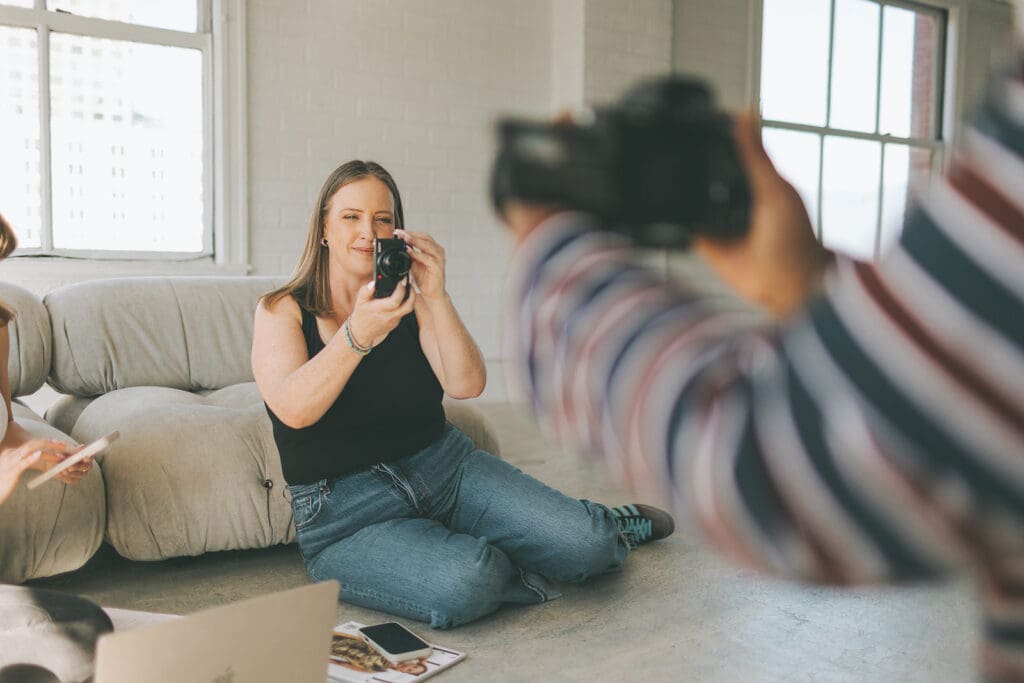
5. Capture Products, Services, and the Details
Do not only film the obvious finished shot.
For products, capture someone holding, opening, using, or packaging them. Get the label, texture, packaging, and smaller branded details.
For services, capture the experience around the result. That could include the consultation, setup, tools, workspace, process, or room preparation.
Then zoom in even further.
Hands, tools, textures, signage, menus, equipment, decor, and branded details might not feel like the hero shots of the day, but they are useful for transitions, Story backgrounds, Reel intros, and montages.
Hold each clip for a few seconds longer than feels necessary too. A shot that ends almost immediately becomes a lot less helpful when you start editing.
6. Get More Than One Version of Important Shots
If a shot matters, do not film it once.
Change the angle. Move closer. Add movement. Record one with a person in frame and another without.
You do not need twenty takes of everything, but variety is what turns one shoot into a content bank rather than content for one post.
A polished product clip might support a launch now and become B-roll behind an educational voiceover a month later.
That flexibility is worth the extra few seconds while you are already filming.
7. Leave Room for the Unplanned Stuff
Your shot list should keep you organized, not hold the entire day hostage.
Some of the best clips happen between planned ones. Someone laughs after messing up a line. A natural team interaction happens. The lighting suddenly looks perfect. Someone has a better idea halfway through.
Film it.
Having a plan does not mean everything needs to feel staged. Those natural moments are often what stop the final content from looking like one giant advertisement.
Build a Content Bank, Not Just a Post
The goal of a content shoot is not to walk away with one perfect Reel.
It is to have enough variety that when you need footage of your team, process, space, service, or product a few weeks later, you already have it.
Organize your shot list by B-roll, people, processes, products or services, details, and talking clips. Get a few variations of the important shots, then leave room for whatever happens naturally.
And if making the shot list is one thing but directing, filming, photographing, and making sure you leave with enough usable content is another, TaSa’s Content Days are built around creating a fresh bank of branded photo and video in one focused shoot.
Your camera roll should be helping you create content, not reminding you what you forgot to film.
Team TaSa

